The Most Important Takeaways
- Payson buyers currently have more choices and greater negotiating room than they had during the most competitive post-pandemic years.
- Affordability remains difficult because home prices, mortgage rates, insurance, taxes, and household income all affect the monthly payment.
- CSI estimated an immediate statewide housing shortfall of 55,992 units in 2025, but its county-level estimate for Gila County was much smaller and preliminary.
- A county can add housing units without necessarily producing the location, property type, or price point that local workers and first-time buyers need.
- New 2026 laws involving deeds, unlawful occupants, HOA disclosures, and insurance models may affect Arizona property owners and transactions.
Why Affordability Remains Difficult
Housing affordability comes down to more than the price of a home. What a buyer pays each month also depends on mortgage rates, property taxes, homeowners insurance, HOA fees where applicable, utilities, and the amount available for a down payment. So, even when home prices dip slightly, the monthly payment may still be out of reach.
The numbers from the Common Sense Institute show just how much the situation has changed. In its May 2026 report, CSI estimated that an Arizona household needed about $86,986 a year to cover the mortgage payment on an average-priced home, based on conventional underwriting assumptions. At that level, just 42% of households could afford the payment without crossing CSI’s 28% housing-cost benchmark. Back in 2019, the estimate was 66%.
Those are statewide estimates, not a mortgage quote and not a statement about what any particular buyer can afford. They are useful because they show why many qualified households still feel squeezed even after the rapid price increases of 2020 through 2022 have ended.

CSI estimated that 42% of Arizona households could afford the monthly mortgage on the average-priced home under its conventional benchmark.
More Homes for Sale Today Does Not Erase the Long-Term Shortage
This is where the numbers can be a little misleading. A market can have more homes for sale, properties sitting longer, and sellers offering concessions, yet still not have enough housing to meet long-term needs. Current inventory simply tells us how many homes are available to buyers right now. The bigger question is whether enough housing exists to keep up with the number of households, normal vacancies, homes that need to be replaced, and future demand.
CSI estimated an immediate Arizona housing shortfall of 55,992 units in 2025. It also reported that permitting slowed during 2025. CSI characterized the shortfall figures as preliminary and explained that its market-based estimate can change as vacancy rates and buyer demand change.

CSI estimated Arizona’s immediate 2025 housing shortfall at 55,992 units. The figure is preliminary and market-based.
What the Gila County Estimate Tells Us
The county-level figures provide a more useful starting point for Payson than the statewide total. CSI’s preliminary table estimated a 447-unit housing deficit in Gila County in 2025, equal to approximately 1.4% of the county’s existing housing stock. With 174 residential permits reported for the year, CSI estimated it would take approximately 2.96 years to close that gap if the relevant conditions remained constant.
That is far more manageable than the statewide projection, but it does not prove that every local housing need is being met. The calculation does not tell us whether the new units are in Payson, Globe, or another part of Gila County. It also does not tell us whether the units are rentals or ownership opportunities, or whether they are attainable for local teachers, health-care workers, public-safety employees, service workers, and first-time buyers.
Housing conditions can change quite a bit from one part of Rim Country to another. Payson, Pine, Strawberry, Star Valley, Christopher Creek, Tonto Basin, Happy Jack, and the private golf communities each come with their own mix of land limitations, utilities, home types, prices, and buyers. Countywide numbers can help show the bigger picture, but they don’t always tell you what is happening in a specific community.

CSI’s preliminary 2025 Gila County estimate provides local context, but it does not measure whether new homes match local price points or locations.
What is Happening in the Payson Housing Market Now
Local MLS figures show what is happening in the market right now. During the 12 months ending July 31, 2026, 859 residential properties closed across the CAAR market, with a median sale price of $437,000. Active inventory rose from 314 listings in January to 535 in July, while months of inventory increased from about 4.6 to 7.4 months.
Buyers working with Payson, AZ realtors now have more homes to look at and more time to make a decision. There may also be more room to negotiate on price, repairs, or other terms. Affordability is still a concern, though. Interest rates, insurance, utilities, property condition, and future repairs all add to the cost.
Sellers are dealing with more competition as a result. Buyers have other options and may pass on a home that needs work or is priced too high. Homes are still selling, just without the same rush we saw in the earlier post-pandemic market.

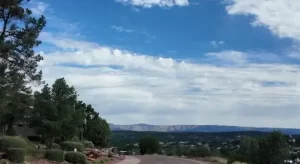
Payson-area buyers had more choices by July 2026. Photo and local MLS analysis by Dennis R. Riccio.
Why Adding the Right Housing Remains Difficult
In Payson and the surrounding mountain communities, the supply discussion is not simply about finding an empty parcel. Topography, access, water and sewer availability, utility extensions, construction labor, material costs, wildfire considerations, zoning, and permitting can all affect whether a site can realistically support housing at a price buyers can afford.
That makes a faster, more predictable permitting process important, but it can only do so much. Faster approvals won’t make a difficult site easier to build on, solve missing infrastructure, or remove other construction costs. Still, unnecessary delays can cost builders money, and some of that added expense may eventually be reflected in the home’s price.
A sound housing strategy therefore needs several things to work together – appropriate land, reliable infrastructure, adequate water planning, predictable review, a range of housing types, and careful attention to the price points local households can properly support.
What the Statewide Data Says About Short-Term Rentals
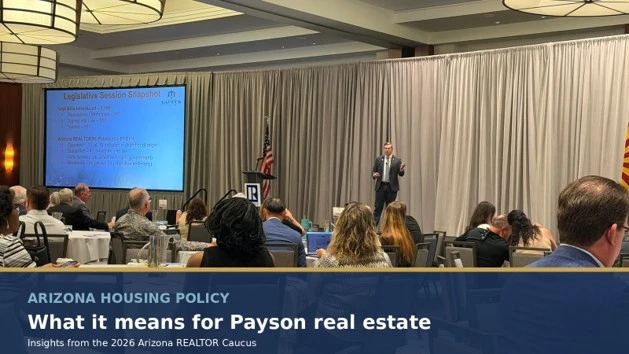
Short-term rentals are particularly relevant in tourism-oriented communities. At the caucus, Ratlief presented a statewide analysis indicating that communities with greater Airbnb concentration did not experience faster housing-price growth after identified outliers were removed. CSI therefore did not find evidence in that analysis that short-term rentals were a meaningful statewide cause of Arizona’s affordability problem.
But that finding needs some context. A statewide trend doesn’t mean short-term rentals have no effect at the neighborhood level. In Payson and other Rim Country communities, legal vacation rentals can support local tourism while providing property owners with additional income. At the same time, a particular rental can cause problems with parking, noise, safety, or other neighborhood concerns. The focus should be on what is actually causing the local problem and on separating responsible rental owners from properties with repeated issues.
Read More – Best Neighborhoods To Live In Payson, AZ
Four 2026 Property Issues Arizona Owners Should Watch
The legislative presentation also highlighted several measures that may affect property owners and real estate transactions. The following is a general summary, not legal advice, and effective dates or implementation details should be checked for a specific transaction.
1. Deed and title safeguards
SB 1479 was signed into law as Chapter 31 and brings several changes aimed at real estate documents and property records. Certain documents recorded in person now come with identification requirements. By January 1, 2027, county assessors must also offer an opt-in system that alerts property owners to changes in ownership or mailing addresses. The law adds fingerprint requirements to notary journals for certain documents, with some exceptions. It also raises the penalty for knowingly recording certain false claims against real property from a class 1 misdemeanor to a class 5 felony.
2. Expedited process for defined unlawful occupants
SB 1426 was signed into law as Chapter 69. It gives Arizona property owners an expanded forcible-detainer process when an unauthorized person is living in a residential property, as long as the situation meets the specific conditions set out in the law. It also directs the Arizona Supreme Court to establish rules for handling these cases more quickly. The expedited process does not apply to ordinary landlord-tenant disputes or certain other relationships that the law specifically excludes.
3. Expanded HOA resale information
HB 2397 was signed into law as Chapter 249. It changes the resale disclosure requirements for condominiums and planned communities. Depending on the type and size of the association, buyers may receive more information about finances, insurance, declarant control, and other association matters. Even with these added disclosures, buyers should read the entire package, keep an eye on the deadlines, and look closely at assessments, reserves, insurance, litigation, and any restrictions that could affect them in that particular community.
4. Insurance modeling and data
HB 2174 was signed as Chapter 247. It requires modeling and data organizations to file models used by insurers for rate-making with the Arizona Department of Insurance and Financial Institutions and allows the department to require supporting information to verify statutory compliance. It does not guarantee lower premiums, but it changes the regulatory review of models that may influence rates.

Four property-related measures signed in 2026. Consult the current statutes and professional advisers for a specific matter.
What This Means for a Payson Buyer
- Look at what the home will cost you each month, not just the asking price. Factor in taxes, insurance, HOA fees, utilities, and any repairs you may need to make.
- Check on insurance early in the process, especially if wildfire risk, an older roof, previous claims, or the property’s condition could affect your coverage.
- Go through the HOA documents and financial disclosures as soon as you receive them. Special assessments, reserve funds, ongoing litigation, insurance deductibles, or restrictions on how you can use the property could change how you feel about the purchase.
- Verify water, sewer, or septic, permits, access, and other property-specific issues rather than relying on a general description of the neighborhood.
- Use the additional inventory to compare condition and value carefully. More choice is useful only when the alternatives are evaluated on the same terms.
What This Means for a Payson Seller
- Price your home based on what you’re competing with today, not what the market looked like at its 2021 or 2022 peak.
- Deal with questions about insurance, the roof, permits, septic systems or utilities, and HOA requirements early, rather than letting them become surprises later in the transaction.
- Prepare the property for buyers who now have more alternatives and more leverage to compare condition.
- Market the specific value of the home and its location. Payson and Rim Country are not one uniform market.
My Perspective on Payson Real Estate
It is easy to look at home prices, inventory, building permits, or shortage estimates and assume they tell us where the housing market stands. They don’t always. Payson can have more homes for sale today and still be short on workforce and attainable housing for the years ahead. The same is true across Gila County. Even if the estimated overall shortage looks fairly modest, certain communities and price ranges may still have too few homes available.
For buyers and sellers, statewide numbers are a useful starting point, but they only tell part of the story. Current MLS data and a closer look at the individual property can tell you much more about the decision in front of you. That local perspective from a Payson, AZ real estate agent matters when you’re buying or selling a home.
If you’re thinking about a move in Payson, Pine, Strawberry, Star Valley, or elsewhere in Rim Country, I’m happy to help you make sense of the local market, look closely at your options, and spot the details that could affect your transaction.
Frequently Asked Questions
1. Does rising inventory mean Arizona no longer has a housing shortage?
No. More homes on the market can give buyers more choices without solving the area’s housing shortage. Active inventory only tells us what is available for sale right now. The shortage is a longer-term issue. It depends on how much housing is available for the people who live there, along with vacancies, homes that need to be replaced, and future growth. So, the market can offer buyers more choices today and still need more housing down the road.
2. Does the 447-unit estimate mean Gila County needs exactly 447 new homes?
No. It is a preliminary CSI estimate based on a market-oriented methodology and countywide data. It can change as vacancy, demand, household formation, and permitting data change. It also does not specify where units are needed or at what price.
3. Are short-term rentals the cause of Payson’s affordability problem?
The statewide analysis presented at the caucus did not find greater short-term-rental concentration associated with faster price growth after identified outliers were removed. That does not rule out local effects. Payson-area policy should distinguish statewide affordability from documented neighborhood impacts and nuisance enforcement.
4. Is Payson currently a buyer’s market?
By July 2026, there were considerably more homes on the market, giving buyers more to choose from and more room to negotiate. But the picture can change depending on the price, location, condition, and type of property. That is why Payson, AZ realtors still look at each property and its local market individually.
5. What should a Payson buyer investigate beyond price?
Things to look at may include financing, insurance, HOA documents, water source, sewer or septic, permits, access, roof condition, wildfire risk, overall property condition, and expected maintenance. What matters most will depend on the property.
Sources and Important Qualifications
- Common Sense Institute Arizona housing report
- Arizona Legislature summary of SB 1479
- Arizona Legislature summary of SB 1426
- Arizona Legislature summary of HB 2397
- Arizona Legislature summary of HB 2174
Local market figures come from CAAR MLS data analyzed by Dennis R. Riccio for the 12 months ending July 31, 2026. CSI figures are estimates, and some of the local figures for 2025 were preliminary. This article is for general information about real estate and policy and should not be considered legal, tax, insurance, lending, or investment advice.