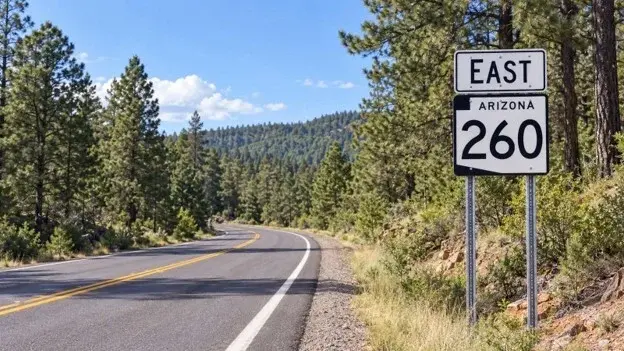
State Route 260 runs through much of Rim Country, where state right-of-way rules can apply in addition to local sign codes.
A practical guide for sellers, homeowners, and open house hosts
By Dennis Riccio, REALTOR® | West USA Realty – Payson
The short answer is usually yes: a seller can display a standard for-sale sign on the property being offered. The details become more complicated when the sign is placed on a neighboring lot, at a turn in the road, within an HOA, beside State Route 260, or in an area that looks public but is actually a roadway easement or right-of-way.
Rim Country does not have one sign rule. Payson and Star Valley are incorporated towns with their own requirements. Pine, Strawberry, Christopher Creek, and Tonto Basin generally fall under Gila County. Happy Jack and Forest Lakes fall under Coconino County. The correct rule therefore depends first on the exact location of the sign.
Start With the Correct Jurisdiction
| Community | Authority | What sellers should know |
|---|---|---|
| Payson | Town of Payson | Town Code plus the Town’s written interpretation of real estate directional signs. |
| Star Valley | Town of Star Valley | Separate zoning and sign-permit process. Do not assume the Payson interpretation applies. |
| Pine, Strawberry, Christopher Creek and Tonto Basin | Gila County | County zoning controls, and the parcel’s zoning classification can change the applicable details. |
| Happy Jack and Forest Lakes | Coconino County | County rules distinguish on-site listing signs from narrowly limited open-house signs. |
Selling Property in Payson
The Town of Payson permits a temporary sale, lease, or rental sign announcing that a specific property is available. Take a look at the rules for a typical residential listing:
- No more than one sale, lease or rental sign is permitted per subdivided lot.
- The sign may be up to six square feet when the listed parcel is one acre or less, or 16 square feet when the parcel exceeds one acre.
- A qualifying real estate sign does not require a Town sign permit.
- In a residential zone, the sign may be placed in the unimproved Town right-of-way adjacent to the listed property, so long as it does not create a traffic or visibility hazard and otherwise complies with the Code.
Directional Signs in Payson
Directional signs have caused more confusion than the sign placed at the listing itself. In written clarification provided to the local real estate community, the Town explained that a directional sign used with the sale, lease or rental of a specific property may be treated as real estate signage under subsection 154-05-005(C)(3). Under that interpretation:
- A separate sign permit is not required.
- The 60-day limitation for general temporary directional signs does not apply.
- The size limit is based on the acreage of the property being offered, not the acreage of the neighboring property where the directional sign is placed.
- A sign may be placed on another private property with that owner’s permission.
- Only one sign is allowed for each actual change in direction. Repeating signs along a straight route or clustering several signs at one location is not permitted by the Town’s interpretation.
Property-owner permission is only one part of the picture. A neighbor cannot authorize a sign in a public median, on someone else’s property, or anywhere the Town Code does not allow it. In Payson, the right-of-way allowance applies only to the unimproved right-of-way next to the property being offered for sale. It does not allow signs elsewhere along the route, and signs are not permitted in roadway medians.
Selling Property in Star Valley
Star Valley is incorporated and applies its own zoning and sign rules. The Town’s posted materials include a sign-permit process. For R1 residential property, the ordinance limits real estate sale signs to four square feet and one sign for every 200 feet of street frontage. It also prohibits signs in an existing or projected street right-of-way or street easement.
The conservative approach is to confirm an off-property or directional sign with the Town before placing it. Permission from a neighboring property owner does not automatically establish that the sign is allowed, and visibility from State Route 260 can add a separate state-law issue.
Signs in Pine, Strawberry, Christopher Creek, and Tonto Basin
These communities are generally unincorporated areas governed by the Gila County Planning and Zoning Ordinance. The parcel’s zoning classification matters, so a rule written for an R1 property should not automatically be applied to an RR, GR, SR, SFR, or other district.
In an R1 residential district, the County ordinance limits a real estate sale sign to four square feet and one sign for every 200 feet of street frontage. The ordinance also states that signs other than traffic-safety signs are not allowed in an existing or projected street right-of-way or street easement. Off-site advertising is addressed under more restrictive commercial provisions rather than through a broad residential exception for listing-direction signs.
For sellers, this means a neighbor’s consent should not be treated as the final answer. Before an off-property sign is installed, the zoning district and proposed location should be confirmed with Gila County Community Development.
Signs in Happy Jack and Forest Lakes
Coconino County’s ordinance is more explicit about the difference between a sign at the property and an off-property open-house sign.
On-Site Sale and Rental Signs
- One unlit sign is allowed on each street frontage adjoining the property.
- The maximum area is six square feet, and a freestanding sign may not exceed six feet in height.
- The sign must be removed within 30 days after the sale.
- A County sign permit is not required for a qualifying real estate sale, rental, or open-house sign.
Temporary Open House Signs
- Each sign is limited to four square feet and three feet in height.
- Signs may be displayed no more than two days per week for a particular property.
- One on-site sign and no more than three off-premise signs are permitted.
- Signs may be placed no earlier than 30 minutes before the open house and must be removed within 30 minutes after it ends.
- The signs may not obstruct traffic visibility, sidewalks, or multi-purpose paths.
- Permission is required when a sign is placed on another person’s private property or private easement. Public placement may require separate encroachment approval.

In Happy Jack and Forest Lakes, Coconino County provides a specific and time-limited exception for qualifying open-house signs.
What if the Property Is in an HOA
Arizona law limits how planned communities and condominium associations may regulate ordinary for-sale, rent, lease, and temporary open-house signs. In general, an association may not prohibit an industry-standard sign on the owner’s property and may not require the owner or agent to use the association’s preferred sign. The statutes generally recognize a sign up to 18 by 24 inches and a rider up to 6 by 24 inches, subject to the statutory details.
Those protections do not create a right to use another owner’s lot, an HOA common area, a roadway median, or public land. An association may also prohibit open-house signs on common areas. If you’re a seller or an agent, you must check both the governmental rule and the governing community documents.
Signs Near State Route 260 and Other State Highways
ADOT distinguishes between an on-premise sign and an off-premise sign. A for-sale or lease sign advertising the property where it is located is exempt from the State’s outdoor-advertising permit requirements for size, location, and spacing. A sign advertising a different property is off-premise advertising and may require State approval when it is along a regulated highway.
Local permission does not replace ADOT approval, and an outdoor advertising sign is not authorized merely because someone has placed it near the highway. This distinction is especially important in Rim Country because State Route 260 passes through or near so many of the communities covered by this guide.
A Seller Checklist Before the Sign Goes Up
- Identify whether the property is in Payson, Star Valley, unincorporated Gila County or unincorporated Coconino County.
- Confirm whether the proposed sign is on the listed property or advertises a different property.
- Verify private-property permission for every off-property location.
- Make sure the location is not a median, highway shoulder, roadway easement or public right-of-way.
- Check the permitted size, number, height, duration and permit requirements.
- Review any HOA or condominium restrictions that apply to the property or proposed sign location.
- Determine whether ADOT rules apply because of proximity or visibility from a state highway.