This Article May Be Helpful If You Are:
- Buying a manufactured home in Payson or Gila County.
- Selling a park model or RV-type property.
- Looking at a property with a carport, awning, deck, porch, or addition.
- Trying to understand whether a property is part of real estate or personal property.
- Trying to gather documents before listing.
- Trying to avoid last-minute inspection, lender, insurance, park approval, or permitting issues.
Start by Identifying the Property Type
Not every “mobile home,” “manufactured home,” “park model,” or “RV” is treated the same way.
A HUD-code manufactured home is different from a pre-HUD mobile home. A park model may be treated differently from a manufactured home. A recreational vehicle is not necessarily treated the same way as a home affixed to real property. A factory-built building is another category.
Before buying or selling, it is important to identify the unit type.
Questions to ask include:
- Is it a manufactured home, mobile home, park model, RV-type unit, or factory-built building?
- Is it affixed to the land?
- Is there an affidavit of affixture?
- Is it being sold as real property or personal property?
- Is it located on owned land, leased land, in a manufactured-home community, in a mobile-home park, in an RV park, or on rural property?
- Are there park or community rules that apply?
The answer can affect the documents needed, the inspections that should be performed, and the requirements that may apply.
For Buyers
Ask classification, title, affixture, tie-down, foundation, permit, floodplain, park, lender, insurance, and accessory-structure questions early in the inspection period. A general home inspection may not address every issue.
For Sellers
Before listing, gather all the documents you have, for example, title records, affidavit of affixture, installation permits, final inspections, foundation documents, tie-down records, park approvals, floodplain information, and permits or plans for carports, awnings, decks, porches, sheds, garages, or additions.
Why Are Tie-Downs, Foundations & Anchoring Important?
For manufactured homes, tie-downs and foundation systems can be important. These issues may affect safety, installation, financing, insurance, and resale.
That does not mean there is one simple answer for every home. The proper anchoring or foundation system may depend on the unit, manufacturer instructions, installation history, soil conditions, local requirements, lender requirements, and whether a professional or government authority has approved the setup.
For buyers, it’s important to investigate early, while sellers should gather whatever documentation is available.
- If records are available, gather them before the transaction begins. Installation permits, final inspections, foundation certifications, tie-down documentation, engineer reports, and manufacturer installation information can all help answer questions from buyers, lenders, or insurance companies..
- If documentation is missing, that does not always mean the transaction cannot close, but it may become an inspection, financing, insurance, disclosure, or negotiation issue.
Does a Resale Automatically Require New Tie-Downs?
The practical answer is that it depends.
A simple resale of a home already in place may not automatically trigger a retrofit requirement solely because ownership changes. But that does not mean the issue should be ignored.
Tie-down, foundation, or anchoring questions may become important if the home is being moved, reinstalled, rehabilitated, modified, affixed to real property, located in a floodplain, reviewed by a lender, reviewed by an insurer, inspected by a professional, or subject to park or local jurisdiction approval.
For buyers and sellers, the better question is not just, “Is a retrofit automatically required?” The better question is:
“Will this specific transaction require proof of proper installation, anchoring, foundation, permitting, park approval, lender approval, or insurance approval?” That question should be answered during the inspection and due diligence period, not at the last minute before closing. |
Are Park Models and RV-Type Properties the Same?

Park models and RV-type units are common in Rim Country. They may look like small homes, especially when they have skirting, decks, porches, awnings, carports, utility connections, or additions.
But a true park model or RV-type unit may not be regulated the same way as a HUD-code manufactured home. That distinction matters.
A park model or RV-type unit may still be affected by manufacturer setup instructions, park or community rules, local zoning or building requirements, floodplain rules, lender requirements, insurance requirements, utility requirements, and permits for decks, awnings, carports, or additions.
If you are buying or selling a park model, do not assume it is treated the same as a manufactured home. Verify the classification and ask what rules apply to that specific location.
Don’t Overlook Carports, Awnings, Decks, and Additions
Carports, awnings, decks, porches, enclosed rooms, sheds, garages, and other structures can be valuable features. They can also create transaction questions.
A carport or awning may be freestanding, or it may be attached to the home or unit. That distinction can matter because attached structures may raise questions about permits, engineering, manufacturer approval, local approval, park approval, and whether the structure transfers load to the home.
Buyers should ask:
- Was the carport, awning, porch, deck, or addition permitted?
- Are there plans or approvals?
- Is the structure attached or freestanding?
- Does the park or community allow it?
- Does the local jurisdiction require a permit?
- Is the property in a floodplain?
- Will the lender or insurer require anything?
Sellers should gather any available records before listing the property. If records are missing, sellers should disclose what they know and avoid making unsupported statements.
Are There Any Red Flags That Can Be Risky for Your Deal?
If a tie-down, permit, title, park approval, floodplain, or carport issue comes up, it does not automatically mean the transaction cannot close. It means the issue should be identified, disclosed, investigated, and either resolved, negotiated, or accepted by the parties with appropriate guidance.
The problem is not always the issue itself. The bigger problem is discovering it too late.
Common Red Flags to Watch For

Buyers and sellers should slow down and ask more questions when any of the following appear:
These red flags do not always mean there is a deal-breaking problem. They mean the issue should be documented, disclosed, and verified.
Be Careful With Marketing Language
Sellers and agents should be careful with phrases such as:
- “Properly tied down.”
- “Permanent foundation.”
- “Code compliant.”
- “Grandfathered.”
- “No permits needed.”
- “Fully permitted.”
- “HUD compliant.”
Those statements may be risky unless supported by reliable documentation or confirmed by the proper authority or professional.
A safer approach is to use fact-based language. It may include –
“Buyer to verify unit classification, affixture status, foundation/anchoring documentation, permit history, and accessory-structure compliance during the inspection period.”
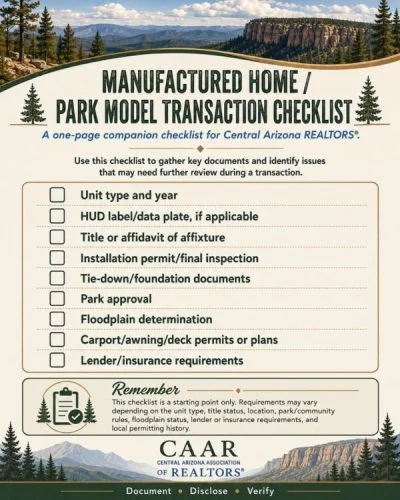
A Simple Checklist for Buyers and Sellers
Before closing, consider asking for or reviewing:
Tips For Buyers
If you are buying a manufactured home, park model, RV-type unit, or property with carports or additions, do your investigation early.
A general home inspection may not answer every question. You may need to contact the local building department, zoning department, floodplain administrator, Arizona Department of Housing / Office of Manufactured Housing, the park or community manager, lender, insurer, licensed installer, engineer, or legal counsel.
Do not wait until the end of the inspection period to ask these questions.
Tips For Sellers
If you are selling one of these properties, start gathering documents before the property goes active.
If you have permits, inspection records, affixture documents, foundation documents, park approvals, or carport/awning/deck permits, organize them early.
If you do not have documentation, be honest about that. It is usually better to disclose uncertainty than to make a statement that later turns out to be unsupported.
Frequently Asked Questions
Are manufactured homes and park models the same in Arizona?
No. Even though they might look similar from the outside, the state of Arizona treats them differently. They have different sets of laws, taxes, and rules. It is super important to double-check exactly what type of home you are dealing with before making any decisions.
Does a manufactured home resale automatically require new tie-downs?
Not necessarily. A sale in place may not automatically require a retrofit solely because ownership changes. But tie-down or foundation issues can still affect financing, insurance, inspections, park approval, appraisal, and closing.
Should I rely on the seller saying the property is “grandfathered”?
Not without proof. People often say a home is “grandfathered” to mean, “It’s old, so it doesn’t have to follow the current rules.” But in real estate, that is a legal claim. Never just take someone’s word for it. Always ask to see the official paperwork or check with local town officials to be sure.
Do carports and awnings matter?
Yes. Attached or freestanding accessory structures may raise questions involving permits, engineering, park rules, local code requirements, floodplain issues, lender requirements, or insurance requirements.
What should I do if records are missing?
Don’t panic, but investigate. Missing paperwork doesn’t mean you can’t buy or sell the home. It just means you have to do some detective work. Buyers should hire a professional to inspect the home carefully, and sellers need to be completely honest about what documents they do and don’t have.
Takeaway
Manufactured homes, mobile homes, park models, RV-type properties, and accessory structures are an important part of the Payson and Rim Country real estate market. They can be great properties, but they require careful attention to classification and documentation.
The safest approach is simple.
- Identify the unit type.
- Gather the available records.
- Disclose what is known and unknown.
- Verify important issues with the proper authority or qualified professional.
Thinking About Buying or Selling in Rim Country? Dennis Riccio Is Here to Help
Manufactured homes, park models, RV-type properties, and homes with carports or additions can be great opportunities in Payson and the surrounding Rim Country. They can also involve details that should be addressed early.
If you are considering buying or selling one of these properties in Payson, Star Valley, Gila County, Pine, Strawberry, Christopher Creek, or nearby communities, contact Dennis Riccio before you list or before your inspection period expires.
As a full-time Realtor, lifelong Arizonan, and Payson resident, Dennis combines local market knowledge with a background in law and business to help clients understand every step of the transaction.
Dealing in real estate under the guidance of Dennis Riccio can help you ask better questions, gather the right documents, and avoid preventable surprises.
Call (928) 517-4550 to speak with Dennis Riccio, West USA Realty Realtor® for for trusted local guidance throughout your real estate journey.
Important Disclaimer
This article is for general educational purposes only. It is not legal advice, engineering advice, code advice, lender advice, insurance advice, installation advice, or a determination that any specific property, unit, foundation, anchoring system, tie-down system, carport, awning, deck, porch, accessory structure, title status, affixture status, or permit history complies with applicable law, code, lender, insurance, park/community, or local jurisdiction requirements.
Requirements may vary depending on the facts, including the type of unit, date of manufacture, title status, affixture status, installation history, location, zoning, floodplain status, park/community rules, lender requirements, insurance requirements, manufacturer instructions, and whether the unit is being sold in place, moved, reinstalled, rehabilitated, affixed, modified, or improved.
Buyers and sellers should consult the applicable local jurisdiction, Arizona Department of Housing / Office of Manufactured Housing, park or community, lender, insurer, licensed installer, registered engineer, home inspector, and/or legal counsel when appropriate.